Beyond

Auditory intelligence for complex human–machine systems.

SoniXense transforms complex information into intuitive auditory experiences that extend human perception beyond visual-only interfaces.

Machines can scale perception.Human attention cannot.

Decision isstill human.

Machine capacity expands

SensorsImagingTrackingAISimulationRoboticsData
Perceptual interfaceVisionAttentionWorking memoryCognitionDecision
One human
decision-maker

One platform for
multimodal medical data.

SoniXense integrates heterogeneous medical and system data, models their dynamics, and transforms them into rich, interactive auditory representations.

01Integrate

Multimodal data

Synchronize and fuse ultrasound/OCT, force sensing, tool pose, robotic states and AI-derived structures.

  • Synchronization
  • Spatial alignment
  • Data fusion
02Model

System dynamics

Extract features and represent physical relationships, interactions and evolving system states.

  • Feature extraction
  • State estimation
  • Interaction models
03Sonify

Sonification engine

Transform modeled dynamics into structured, multidimensional auditory representations.

  • Model-driven
  • Physics-based
  • Adaptive mapping
04Render

Interactive audio

Render spatial and temporal sound in real time through existing audio systems and workflows.

  • Real-time
  • Spatial audio
  • System integration

Put on headphones.
Hear what you would normally watch.

SoniXense should be heard, not over-explained.

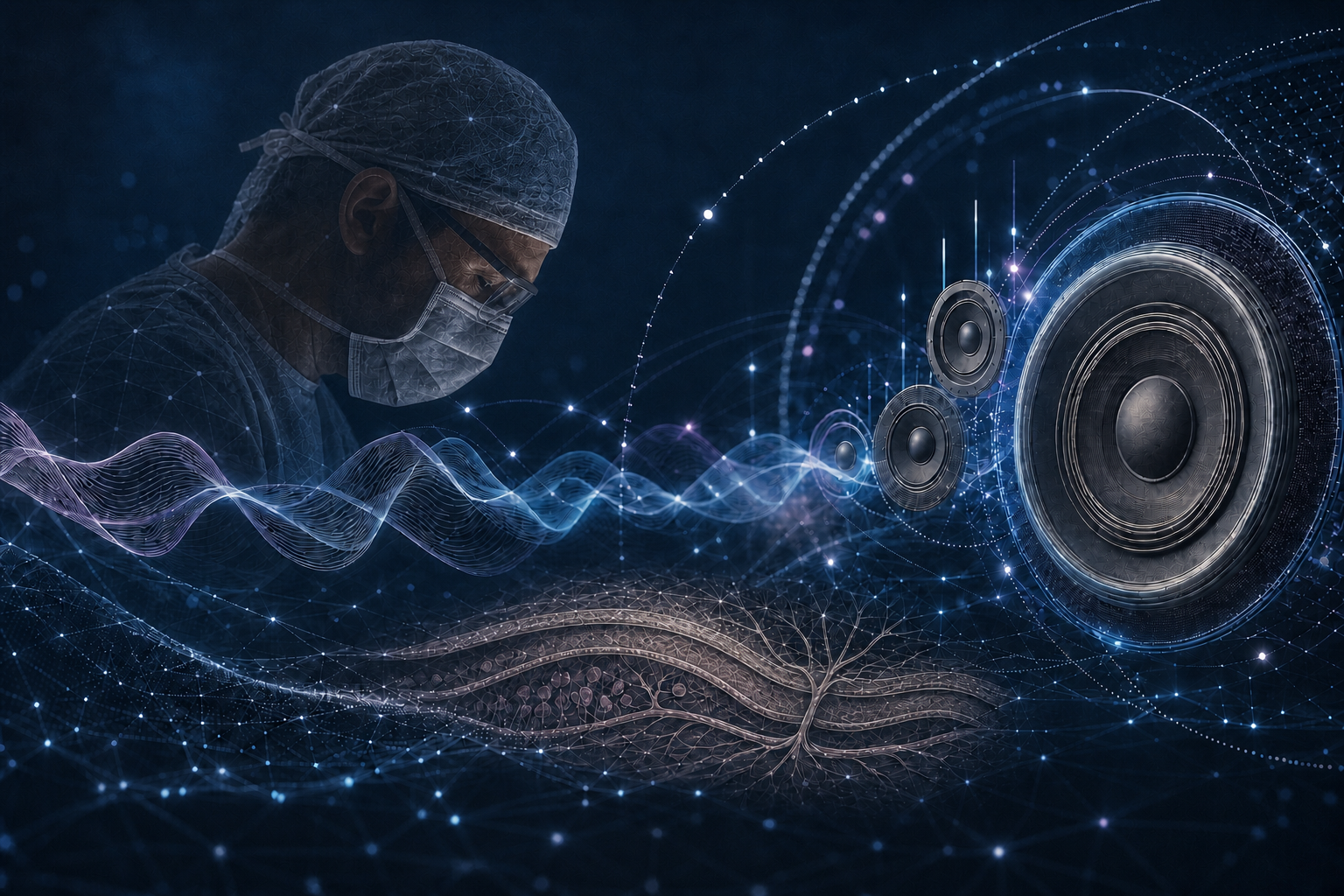
Making surgical interaction audible.

Surgery combines dense multimodal information with continuous physical interaction and time-critical decisions. SoniXense transforms evolving interactions and system states into real-time auditory representations.

From tool–tissue dynamics to sound.

01

Ophthalmic surgery

Microscale tissue interaction

iOCT · imaging · tool tracking

02

Cardiovascular intervention

Catheter–tissue interaction

Imaging · navigation · procedural state

03

Robotic / minimally invasive surgery

Tool–tissue dynamics

Robotic state · interaction sensing · imaging

04

Spine surgery

Spatial navigation

CT / navigation · tracking · trajectory

Built through research.
Protected through invention.

An academic research ecosystem and a portfolio of published patent applications form two foundations for SoniXense.

DFG-funded research project

SYNERGIA

Multisensory Integration in High-Intensity Environments — Bridging AI Analysis and Human Perception

An interdisciplinary project investigating sonification, spatial audio, AI and human perception in demanding surgical environments.

Explore Synergia ↗
Patents / protected technology

DATA-TO-SOUND

Interactive feedback from data and interaction to auditory information.

A published application describes sound output generated from interaction with a multidimensional data set through a sound model.

Explore the application ↗
Peer-reviewed science

MICCAI · IPMI · IEEE · Scientific Reports · Medical Image Analysis

Recognition

3× Sonification Award winner · MICCAI Best Paper finalist

Where technology
becomes ArtScience.

The same technologies that make complex systems perceptible can create entirely new forms of human experience.

Explore SoniXense ArtScience →
MedicineRoboticsXRHuman–AI InteractionArtScience

Technology, medicine,
science, and art.

A multidisciplinary founding team building one perceptual technology platform.

Co-founder profile / CEO / Co-Founder

Dr. Sasan Matinfar

Surgical Sonification & Multisensory Medical Technology

Researcher and inventor connecting computation, medicine, perception and music through surgical sound.

Portrait of Dr. Sasan Matinfar

01 / Signature contribution

From Tissue to Sound

A research framework for transforming multimodal intraoperative information and tool–tissue dynamics into meaningful auditory representations.

Tissue / interactionModelingSound

02 / Biography

Sasan Matinfar is an interdisciplinary researcher exploring how complex surgical information can become perceptually accessible through sound and multisensory interaction. At TUM CAMP, he leads the Sonification Team and serves as Scientific Coordinator of the DFG Synergia project between TUM and TU Dresden.

He conceived From Tissue to Sound, a research framework that connects medical imaging, vibroacoustic sensing and interaction data with computational auditory feedback. His work spans computer-assisted intervention, medical XR, adaptive interfaces and multisensory human–AI interaction.

He earned a PhD in Computer Science summa cum laude from TUM under Prof. Nassir Navab. Studies in Musicology at the University of Music Franz Liszt Weimar and Piano Performance at the Art University of Tehran inform his approach to sound as a way of understanding medical data.

03 / Awards & recognition

Data Sonification Awards

2025 · 2026 ×2

MICCAI Best Paper Award Nominee

2023 · finalist distinction

04 / Selected highlights

Research Lead

CAMP Sonification Team · TUM

Scientific Coordinator

DFG Synergia · TUM / TU Dresden

Interdisciplinary training

Computer science, musicology and piano performance

05 / Work & contribution

Invention & IP

Lead inventor across multiple international patent families in surgical sonification and intelligent surgical assistance. The underlying records include published patents, filed applications and work in preparation; these have different legal statuses.

From Tissue to Sound

Research framework and 2025 Medical Image Analysis publication

Ocular Stethoscope

Auditory support for retinal membrane peeling

Co-founder profile / Chief Innovation Officer / Co-Founder

ArtScience, Sound & Material Intelligence

An ArtScience practice that makes the behavior of matter, machines and complex systems audible.

Portrait of Navid Navab

01 / Signature work

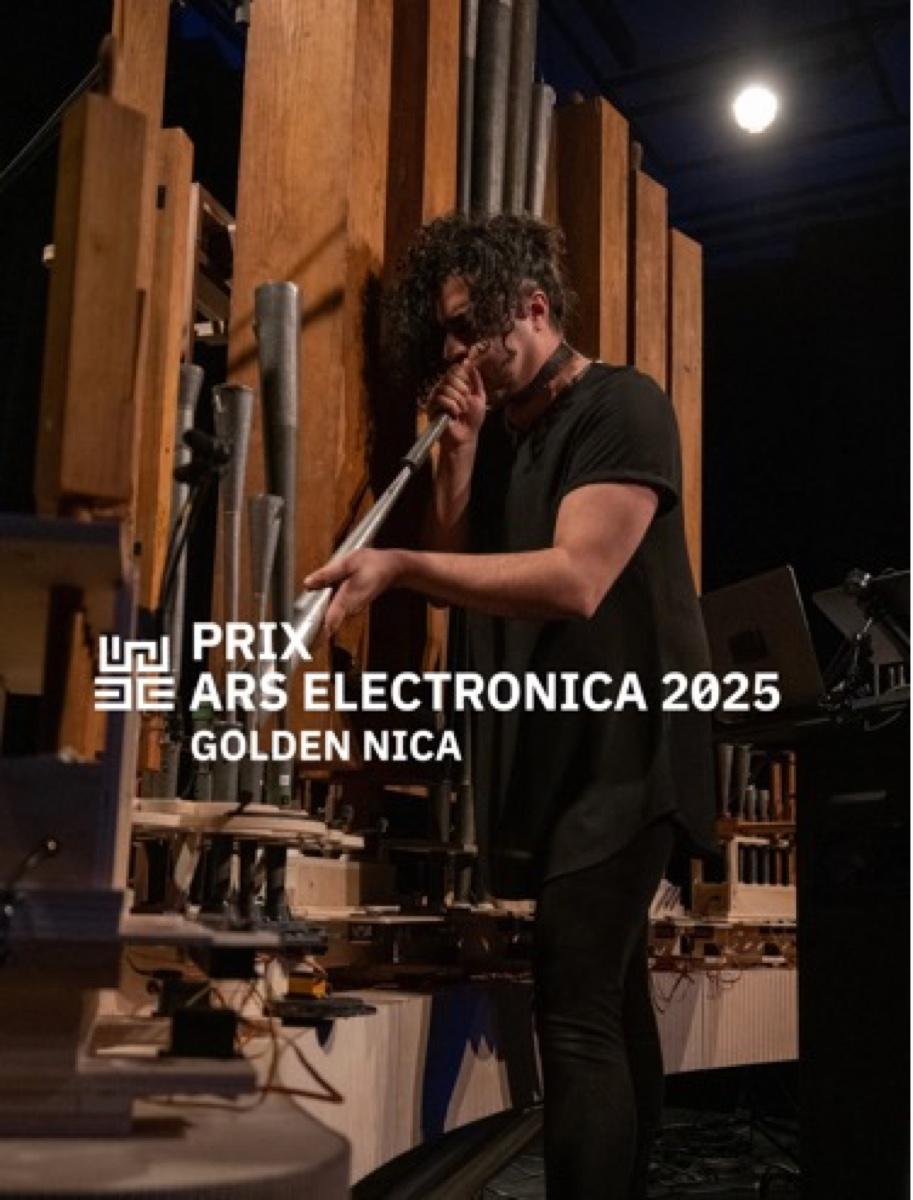
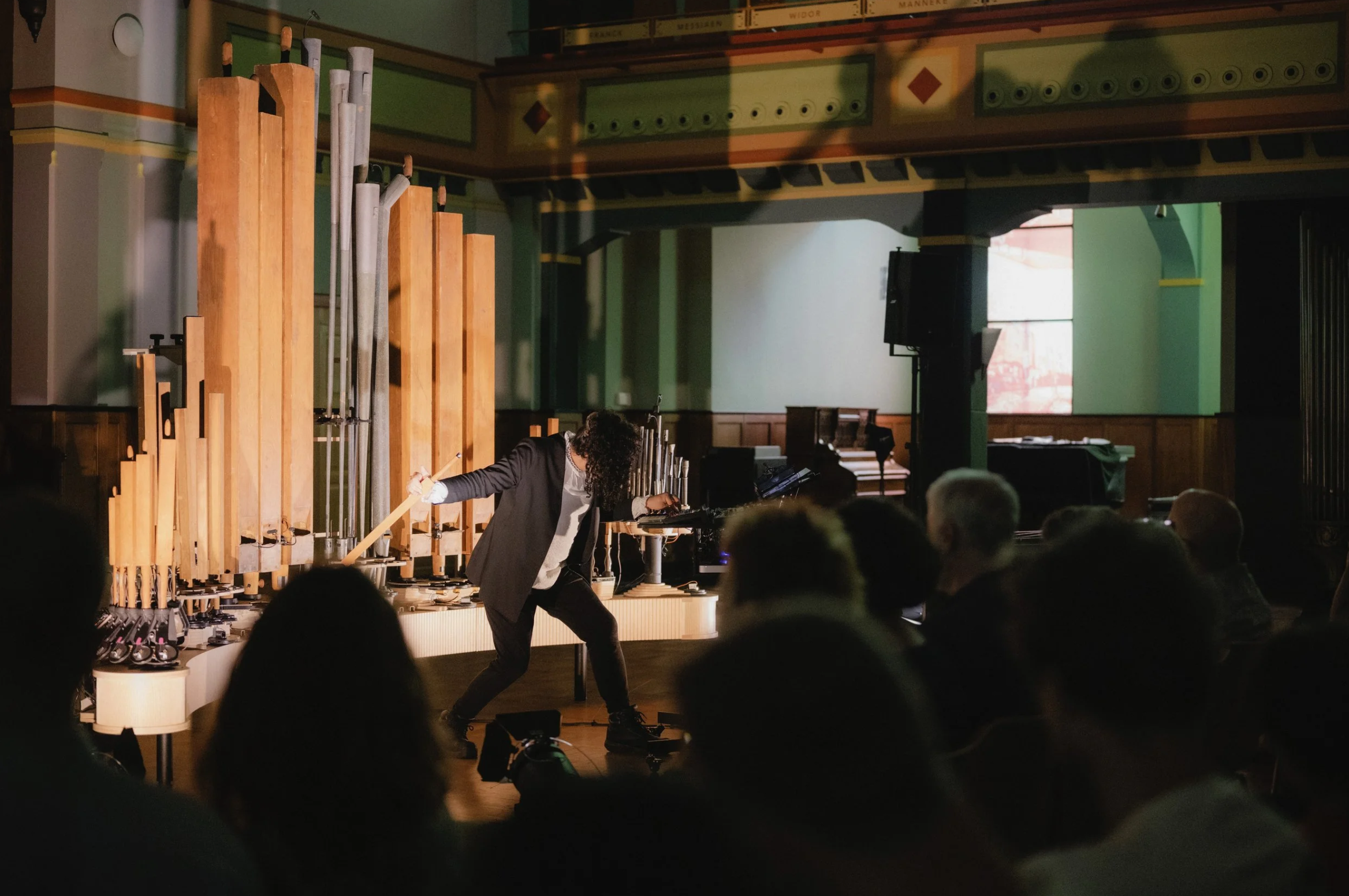
Created with Garnet Willis, the work pairs a robotically prepared historic pipe organ with a robotically steered chaotic pendulum. The work makes nonlinear dynamics and material behavior audible through a responsive technological system.

02 / Biography

Navid Navab is a media artist, composer and ArtScience practitioner whose work draws on contemporary music, biomedical sonification and philosophical biology. Their installations and performances explore how sound emerges from physical behavior, resonance and responsive machines.

Their work spans kinetic sound sculpture, responsive environments and gestural composition, and has been presented internationally. As a researcher, Navab has led interdisciplinary experiments across art, science and technology since 2008 and directs the Topological Media Lab.

For SoniXense, this practice brings a distinctive way of thinking about sound: as a medium through which complex physical processes can be sensed and understood. Organism belongs to this artistic lineage; it is not a medical technology project.

03 / Awards & recognition

Lumen Prize

For Organism

04 / Selected highlights

ArtScience

Sound, kinetic systems and material intelligence

International practice

Installations and performances presented internationally

Topological Media Lab

Director of an interdisciplinary artistic research lab

05 / Work & contribution

Organism

Responsive organ and chaotic pendulum performance installation

Material sound practice

Kinetic sculpture, responsive architecture and gestural composition

Co-founder profile / CTO / Co-Founder

Dr. Veronica Ruozzi

Biomechanical Modeling & Physics-Based Sonification

Biomedical engineer translating the physical behavior of surgical interactions into auditory guidance.

Portrait of Dr. Veronica Ruozzi

01 / Signature contribution

BioSonix

Physics-based sonification of tool–tissue interaction. Biomechanical modeling of tissue deformation drives auditory representations of interaction dynamics and tissue properties.

Tool–tissue interactionBiomechanicsSound

02 / Biography

Veronica Ruozzi is a biomedical engineer and researcher working in physical and numerical modeling of surgical interactions, physics-based sonification and medical XR at TUM CAMP. Her work connects biomechanical simulation with multisensory interfaces for computer-assisted procedures.

She earned a PhD cum laude in Biomedical Engineering from Politecnico di Milano. Her doctoral research studied physics-based extended reality for real-time guidance in minimally invasive cardiovascular interventions.

Her contribution to SoniXense sits at the bridge between tool–tissue interaction and auditory representation: physical changes in tissue can become meaningful sound.

03 / Awards & recognition

04 / Selected highlights

BioSonix

Physics-based tool–tissue sonification

Cardiovascular XR

Physics-based guidance for minimally invasive intervention

Retinal sonification

Physics-based iOCT sonification research for subretinal injection

05 / Work & contribution

Co-founder profile / CSO / Co-Founder

Prof. Dr. Nassir Navab

Medical XR, Robotics & Surgical Intelligence

An internationally recognized pioneer in computer-assisted medical procedures and medical augmented reality.

Portrait of Prof. Dr. Nassir Navab

01 / Foundational contribution

Medical XR & Surgical Intelligence

Decades of research connecting imaging, navigation and computer-assisted medical procedures with new ways to support clinicians.

02 / Biography

Nassir Navab is Professor of Computer Aided Medical Procedures at TUM. His research group develops technologies linking medicine and computer science to improve medical interventions, with work spanning augmented reality, imaging, surgical navigation and intelligent systems.

He completed his doctorate at INRIA / Paris XI, followed by postdoctoral research at the MIT Media Laboratory. Before joining TUM as a full professor in 2003, he was a Distinguished Member of Technical Staff at Siemens Corporate Research in Princeton.

His long research trajectory in computer-assisted intervention and medical XR provides a clinical and computational foundation for the auditory interaction research behind SoniXense.

60+International patents
HundredsScientific publications

04 / Selected highlights

Computer-assisted medicine

TUM chair connecting medical procedures and augmented reality

Scientific leadership

MICCAI Society board member from 2006; editorial service for IEEE TMI, Medical Image Analysis and Medical Physics

Research trajectory

INRIA / Paris XI · MIT Media Laboratory · Siemens Corporate Research · TUM

05 / Work & contribution

Medical augmented reality

Research in imaging and navigation for medical procedures

CAMP research group

Computer-assisted medical procedures and augmented reality at TUM

Built on science.
Protected by IP.

SoniXense is a spin-off in formation emerging from the DFG-funded Synergia project and research at TUM CAMP.

Origin

Research became technology.

Peer-reviewed research, international scientific collaboration, and years of work across sonification, medical imaging, and computer-assisted procedures.

Research originsTUM · CAMP · Synergia

FundingDFG

Scientific community / recognitionMICCAI

Protected technology

An international patent portfolio.

Intellectual property across auditory interaction technologies supports continuity from research into future products and integration pathways.

Auditory Surgical Navigation

Selected patent family

Auditory Support for Retinal Surgery

International patent family

Data-to-Sound Interactive Feedback

European patent
Research progression
2023

MICCAI · Scientific Reports

Surgical guidance and auditory interaction

2024

IEEE TVCG · MICCAI

Multisensory systems and computer-assisted procedures

2025

Medical Image Analysis · IPMI

Physics-based sonification and medical imaging

2026

IEEE Access · MICCAI Spotlight

Auditory intelligence for complex medical systems

3× Sonification Award winner

Built for integration.

SoniXense is designed as a software intelligence layer for existing imaging, sensing, navigation, robotic, and XR systems.

ImagingNavigationRoboticsXRIntelligent sensing
Software intelligence layerSoniXense auditory intelligence

Human perception

Bring auditory intelligence into your system.

Talk to us

Hear beyond vision.

Bring auditory intelligence into your system.

Talk to us →


Research origins · funding · scientific community